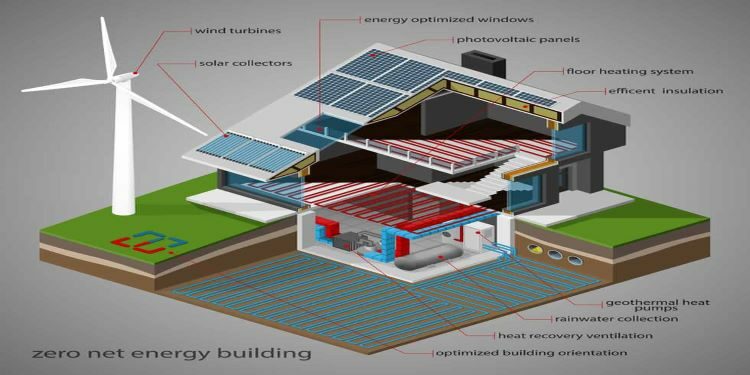
The goal of an energy efficient system is to provide reliability and reduce operational costs.
What are Net Zero Energy Buildings?
Net or nearly zero energy buildings (NZEB) are highly efficient buildings with extremely low energy demand, which is met by renewable energy sources. Such buildings produce as much energy as they consume, accounted for annually.
Net Zero Energy Buildings (NZEB) are the next level of high-performance buildings. India is in a unique position to develop an energy efficient new building stock that is yet to be designed until 2030
How can it be achieved?
In order to achieve their net zero energy goals, NZEBs must first sharply reduce energy demand using energy efficient technologies, and then utilize renewable energy sources (RES) to meet the residual demand. In such buildings, efficiency gains enable the balance of energy needs to be supplied with renewable energy technologies. This is the most logical approach to reach NZEB goal.
Various definitions of Net Zero Energy Buildings(NZEB)
Definitions of NZEB are critical in determining the path to zero energy goals, and significantly influence design choices of architects and building owners. Appropriateness of definitions to a project vary according to project goals and values of the designer and building owner, making it essential for them to understand which definition will suit their purpose best.
NET ZERO SITE ENERGY BUILDING
A site ZEB produces at least as much energy as it uses in a year, when accounted for at the site
Site NZEBs encourage a relentless pursuit of energy efficiency, as the quantum of renewable energy supply options on a given site is limited.
Site Energy refers to the energy consumed and generated at a site (e.g. a building), regardless of where or how that energy originated.
Net Zero Source Energy Building
Source Energy refers to primary energy needed to extract and deliver energy to a site, including the energy that may be lost or wasted in the process of generation, transmission and distribution.
A source ZEB produces at least as much energy as it uses in year, when accounted for at the source
Source or primary energy is the measure of net zero status for source NZEBs. Primary energy is the energy used to generate and deliver secondary energy (predominantly electricity in the case of India) to the site.
Energy supplied to the source NZEB site and exported from it gets multiplied by site-to-source conversion factors which allow energy used for generation in power plants and transmission to be factored.
Net Zero Energy Cost Building
Net Zero Energy Cost is perhaps the simplest metric to use: it means that the building has an energy utility bill of €0 over the course of a year
Net zero energy cost buildings must have low peak demands and higher energy savings so that they have lower price tariffs and in turn, lower utility bills
Cost NZEBs are also not feasible without policies like feed-in-tariff and net metering, which facilitate buying back of electricity by utilities.
Net Zero Energy Emission Building
A Net Zero Energy Emissions building either uses no energy which results in emissions or offsets the emissions by exporting emissions-free energy (typically from on-site renewable energy systems)
A net-zero emissions building produces at least as much emissions-free renewable energy as it uses from emissions-producing energy sources
Carbon, sulphur oxides and nitrogen oxides are included in calculating emissions neutrality